Dave McKenna
·
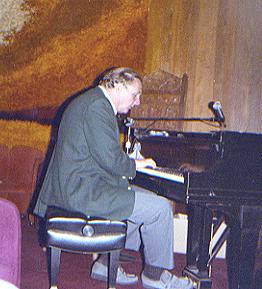
The cornetist Bobby Hackett once called Dave McKenna "the greatest piano player alive." McKenna, being McKenna, would have waved it off — he liked to describe himself, with New England understatement, as a "barroom piano player." The truth sits closer to Hackett's version: McKenna could sound like a whole rhythm section on his own. Among the fifty players in jazz journalist Gene Rizzo's ranking of the greatest jazz pianists, he lands at number 34.
This profile covers who Dave McKenna was, how a Rhode Island bebopper became jazz's great solo swinger, what made his left hand so remarkable, and the recordings — plus scores — to start with today.
The short answer: Dave McKenna (1930–2008) was an American jazz pianist from Woonsocket, Rhode Island, whose self-contained solo style — a walking bass line and chords in the left hand under a hard-swinging right — made him a one-man band with a vast songbook.
Life and career
An independent-minded New Englander, McKenna joined the musicians' union at fifteen after casual study with his mother and his parochial-school teachers, later training more seriously with local instructors. At sixteen he was playing with a small group led by the ex-Kenton altoist Boots Mussulli, and he worked with Charlie Ventura and Woody Herman before being drafted in 1951.
After his 1953 discharge he spent the decade with big names — Gene Krupa, Stan Getz, and the Al Cohn–Zoot Sims group — then Buddy Rich, Bobby Hackett, and Eddie Condon's club. Moving to Cape Cod in 1967, and in close contact with New York's mainstream players, the former bebopper settled into jazz's stylistic middle ground, where he became celebrated as a solo pianist, most famously during a long residency at Boston's Copley Plaza. He died in 2008.
Style and influence
McKenna's signature was that left hand. He could walk a bass line like a string bassist while filling in guitar-like chords, then send his right hand swinging hard over the top — the "three-handed" effect that let him hold a room without bass or drums. Add tasteful harmony and a song repertoire that seemed bottomless, and you have one of the most complete solo pianists jazz has produced.
His heroes, tellingly, were songwriters rather than pianists, and he built medleys around a shared word or theme in the titles — a whole set of "moon" songs, or street names, strung together seamlessly. He recorded Concord tributes to Hoagy Carmichael and Arthur Schwartz, and his repertoire sometimes overlapped Art Tatum's, though his mainstream conservatism steered clear of the more modern harmonic and rhythmic trends of players like Keith Jarrett. Rizzo notes that even the name "jazz musician" made McKenna uneasy — he wanted the tunes to speak first.
Essential recordings
McKenna's best work is solo; these capture the one-man band at his peak:
| Recording | Label / year | Why it matters |
|---|---|---|
| Giant Strides | Concord, 1979 | A solo showcase that made his "three-handed" swing famous beyond the club circuit |
| A Celebration of Hoagy Carmichael | Concord, 1983 | A songwriter tribute that shows his gift for melody and his deep standards repertoire |
| Dancing in the Dark (Music of Arthur Schwartz) | Concord, 1985 | The Arthur Schwartz songbook, and a clinic in thematic solo programming |
| My Friend the Piano | Concord, 1987 | A relaxed solo set that distills his warmth, swing, and self-contained left hand |
Play Dave McKenna's music
McKenna was an interpreter of the Great American Songbook, so the way into his world is through the standards he loved. Try Arthur Schwartz's "Dancing in the Dark" or Hoagy Carmichael's "Georgia on My Mind" and "Stardust," then listen for how his left hand carries the bass and chords at once. A few of his signature pieces are open on MuseScore below.
Where Dave McKenna ranks among jazz pianists
Rizzo places McKenna at 34, closing his ranking with a supreme solo swinger. See the full list in our guide to the best jazz pianists of all time, and compare McKenna with Art Tatum, whose repertoire he sometimes shared, the classically minded Lennie Tristano, and the elegant swing stylist Teddy Wilson. To understand the harmony behind the standards he played, start with our guide to jazz chord progressions.
Frequently asked questions
Why is Dave McKenna called a "three-handed" pianist?
Because his left hand did two jobs at once — walking a bass line while filling in chords — under a hard-swinging right hand. The result sounds like three hands, or a full rhythm section, from a single player.
What are Dave McKenna's famous medleys?
McKenna liked to build medleys around a common word or theme in song titles — moons, dreams, street names, women's names — blending ballads and up-tempo tunes into seamless sets. It became a hallmark of his solo performances.
What should I listen to first?
Start with Giant Strides (1979) for the definitive solo statement, then his Hoagy Carmichael tribute (1983) to hear the songbook side of his art.
See scores on MuseScore
Rate this article
Be the first to rate this articleSee more

Virtual piano
Play a piano in your browser — use your mouse, touch, or computer keyboard. Real piano sound, and a free Pro tab with up to 61 keys, sustain, MIDI keyboard input, a metronome, and recording.

Keyboard ear trainer
Hear a note, then click the matching key on the on-screen piano — with instant feedback, the right key revealed on a miss, and a running score.

Metronome
Set the tempo and time signature and practice in steady time, or open the Pro tab for subdivisions, per-beat accents, a speed trainer, a gap trainer, click sounds, and recording yourself under the click — all free, right in your browser.

Scale finder
Pick a root note and a scale type — major, minor, the modes, pentatonic, blues — and see every note light up on the piano, spelled out for you.

Chord finder
Pick a root note and a chord type — major, minor, sevenths, suspended and more — and see the chord on the piano, named and spelled out for you.

Note finder
Pick a note and see every place it sits on the piano keyboard, named — and tap any key to hear it.