Count Basie
·
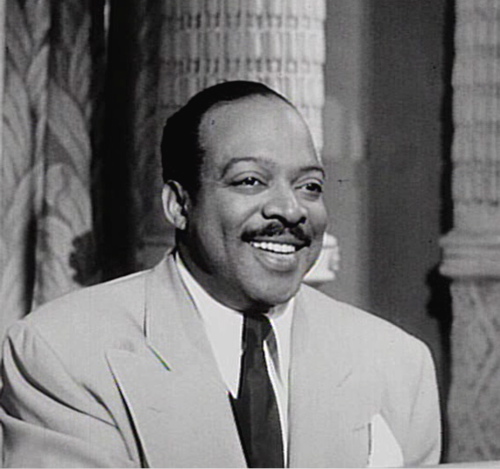
Everyone knows the sound of the Count Basie Orchestra — the whip-crack brass, the effortless glide, the sudden hush before a final chord. Fewer people notice that the man at the piano bench played less than almost anyone else in the room, and that this was the whole idea. Among the fifty players in jazz journalist Gene Rizzo's ranking of the greatest jazz pianists, Basie lands at number 27, and Rizzo's admiration is aimed squarely at the keyboard, not the podium: he calls Basie's playing "ingeniously terse."
This profile covers who Count Basie was, how a stranded vaudeville pianist became a Kansas City bandleader, why his spare style rewards close listening, and the recordings — plus scores — to start with today.
The short answer: Count Basie (1904–1984) was an American pianist and bandleader from Red Bank, New Jersey, whose blues-soaked, perfectly economical stride playing — a few well-placed notes where others crowded the bar — became as recognizable as any run of a hundred.
Life and career
Basie was born in Red Bank in 1904 and learned his trade the hard way, on the road. When a touring theatrical troupe broke up and left him stranded in Kansas City, he found work in the city's crowded band scene, playing with Walter Page's Blue Devils in 1928–29 and then joining Bennie Moten's orchestra, a standard-bearer of Kansas City swing, from 1929 to 1934.
When Moten died suddenly in 1935, the band's members made Basie their leader by unanimous consent. The turning point came in 1936, when producer John Hammond caught the group on a late-night radio broadcast and urged Basie to expand it and bring it east. In New York a loose, riff-driven "head" band built around soloists like Lester Young and Sweets Edison grew into one of the most precise ensembles jazz has ever produced — and stayed on the road, in one form or another, for the rest of Basie's life. He died in 1984.
Style and influence
Basie's piano is the art of leaving things out. Where a stride pianist of his generation might fill every beat, Basie would drop in two or three notes, a glinting high tinkle, a single chord — and let the rhythm section carry the rest. It sounds simple; it is fiendishly hard to time that well.
He came up under Harlem "ticklers" like Willie "The Lion" Smith and Donald Lambert, with encouragement from Fats Waller, and he never lost the stride foundation even as he pared it down. Rizzo, who rates him "an alpha stride player," points to the later Pablo sessions produced by Norman Granz — jam dates and duets with Oscar Peterson — where a choppier, more assertive soloist steps out from behind the orchestra. No composer by temperament and self-deprecating to a fault, Basie usually deferred to the band's arrangements and rarely put himself forward.
Essential recordings
Because Basie so seldom featured himself, the piano is best heard in small doses across the big-band catalogue and, late in life, in Granz's stripped-down sessions:
| Recording | Label / year | Why it matters |
|---|---|---|
| "One O'Clock Jump" | Decca, 1937 | His biggest hit and lifelong theme — a 12-bar blues that opens with Basie's own spare piano |
| The Atomic Mr. Basie | Roulette, 1958 | The late-'50s orchestra at its polished peak; a showcase for how little piano the leader needed |
| Satch and Josh (with Oscar Peterson) | Pablo, 1974 | Two-piano duets that finally put Basie's economy next to Peterson's abundance |
| Basie Jam | Pablo, 1975 | A relaxed small-group blowing session where Basie solos more freely than the big band ever allowed |
Play Count Basie's music
The best way to feel Basie's economy is to play one of his riff tunes and notice how much space the piano leaves. Start with the head of "One O'Clock Jump" or "Jumpin' at the Woodside," then try the famous double-ending arrangement of "April in Paris." A few of his signature vehicles are open on MuseScore below, from lead-sheet simplicity to full big-band scores.
Where Count Basie ranks among jazz pianists
Rizzo places Basie at 27, a ranking aimed at his piano rather than his podium. See the full list in our guide to the best jazz pianists of all time, and compare Basie with his mentor Fats Waller and his fellow bandleader-pianists Duke Ellington and Teddy Wilson. To hear how his blues-based harmony works under the hood, start with our guide to jazz chord progressions.
Frequently asked questions
Was Count Basie a good pianist, or just a bandleader?
Both. His fame rests on the orchestra, but musicians prize his piano precisely for its economy — a spare, blues-rooted stride style with impeccable timing. Rizzo ranks him among the fifty greatest jazz pianists for the playing, not the podium.
What is Count Basie's most famous piece?
"One O'Clock Jump," a 12-bar blues he introduced in 1937, became his signature theme and closed his concerts for decades. It opens with his own instantly recognizable piano before the full band enters.
What should I listen to first?
Start with the 1937 "One O'Clock Jump" for the classic band sound, then hear Satch and Josh (1974) with Oscar Peterson to catch Basie soloing at length — the clearest showcase of the pianist behind the bandleader.
See scores on MuseScore
Rate this article
Be the first to rate this articleSee more

Virtual piano
Play a piano in your browser — use your mouse, touch, or computer keyboard. Real piano sound, and a free Pro tab with up to 61 keys, sustain, MIDI keyboard input, a metronome, and recording.

Keyboard ear trainer
Hear a note, then click the matching key on the on-screen piano — with instant feedback, the right key revealed on a miss, and a running score.

Metronome
Set the tempo and time signature and practice in steady time, or open the Pro tab for subdivisions, per-beat accents, a speed trainer, a gap trainer, click sounds, and recording yourself under the click — all free, right in your browser.

Scale finder
Pick a root note and a scale type — major, minor, the modes, pentatonic, blues — and see every note light up on the piano, spelled out for you.

Chord finder
Pick a root note and a chord type — major, minor, sevenths, suspended and more — and see the chord on the piano, named and spelled out for you.

Note finder
Pick a note and see every place it sits on the piano keyboard, named — and tap any key to hear it.