Mary Lou Williams
·
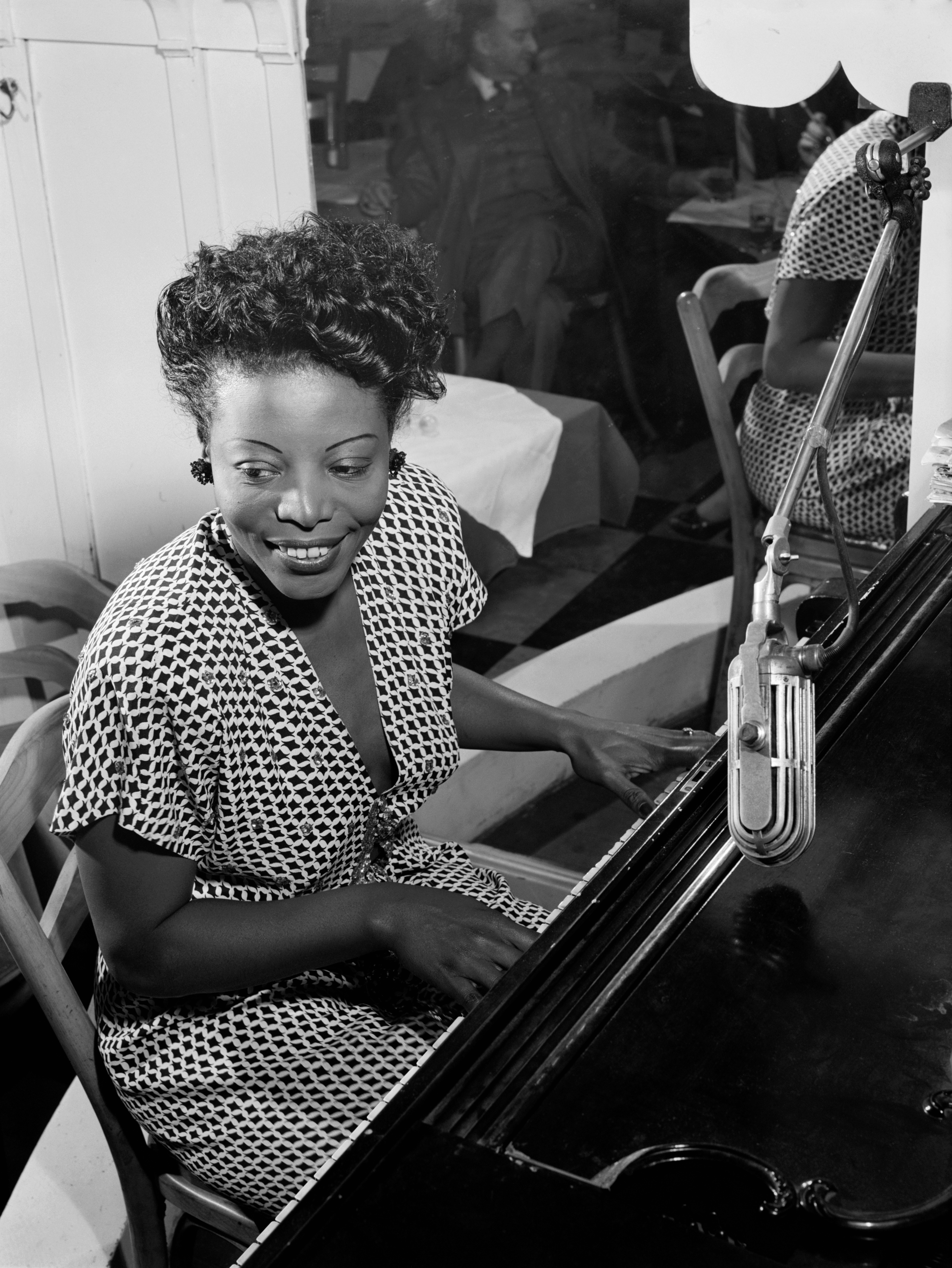
Among the fifty players in jazz journalist Gene Rizzo's ranking of the greatest jazz pianists, Mary Lou Williams stands at number 47 — the highest-placed woman on the list and one of the very few musicians who lived through, and shaped, nearly every era of jazz. Pianist, composer and arranger, she moved from Kansas City swing to bebop to sacred music without ever losing her own voice, and she mentored some of the music's greatest figures along the way.
This profile covers who Mary Lou Williams was, how a self-taught prodigy became jazz's great connector across eras, what made her playing and writing singular, and the recordings — plus scores — to start with today.
The short answer: Mary Lou Williams (1910–1981) was an American jazz pianist, composer and arranger, entirely self-taught, whose career spanned from the swing era to the avant-garde and who opened doors for women in jazz beyond the vocal booth.
Life and career
Williams grew up in Pittsburgh, where as a child she spent hours at the family's player piano, slowing down the rolls to dissect the playing of Jelly Roll Morton and James P. Johnson. She never had a formal lesson. By nineteen she was already a veteran of gin joints and vaudeville, and she joined a band led by her future husband, John Williams.
Her long tenure with Andy Kirk and his Clouds of Joy, from 1931 to 1942, made her reputation as both a featured soloist and the band's principal arranger. In the 1940s she became an early champion of bebop, informally tutoring Thelonious Monk and Bud Powell and hosting jam sessions at her Harlem apartment. She premiered her extended Zodiac Suite in 1945, spent the early 1950s in Europe, and after converting to Catholicism in 1957 devoted much of her later work to sacred music, including Mary Lou's Mass. She taught at Duke University, ran a thrift shop to help needy musicians, and in 1977 played duets at Carnegie Hall with the avant-gardist Cecil Taylor. She died of cancer in Durham, North Carolina, in 1981.
Style and influence
Williams's playing absorbed everything she heard and made it her own — the boogie and stride of her youth, the swing of Kansas City, the harmonic daring of bebop, and later the freedom of the avant-garde. Her arrangements were so intricate that Rizzo calls her writing "a transcriber's nightmare," a compliment to music too rich to pin down easily on paper.
Her influence ran in two directions. As a mentor she helped shape Monk and Powell at the birth of bebop; as a trailblazer she cleared a path for later women in jazz such as Marian McPartland, Barbara Carroll and Eliane Elias in what Rizzo bluntly calls the "good ol' boy" days of the music. She drew her own foundations from Morton, Johnson and Earl Hines, then carried them somewhere entirely new.
Essential recordings
Williams's discography stretches across labels and decades; these entries mark the turning points:
| Recording | Label / year | Why it matters |
|---|---|---|
| Zodiac Suite | Asch, 1945 | Her ambitious twelve-part fusion of jazz and classical form — proof of her range as a composer |
| Andy Kirk and His Clouds of Joy (as soloist / arranger) | Decca, 1930s | The swing-era work, including "Walkin' and Swingin'," that first made her reputation |
| Newport appearance with Dizzy Gillespie | Verve, 1957 | The performance that ended a semi-retirement and reasserted her place in modern jazz |
Play Mary Lou Williams's music
Because Williams wrote so much of her own material, you can play her music directly rather than through the standards of others. Start with "Roll 'Em," the boogie-woogie feature she wrote for Benny Goodman, then explore the swing gem "Walkin' and Swingin'" and movements from her Zodiac Suite. A few of those pieces are open on MuseScore below, in arrangements from approachable to advanced.
Where Mary Lou Williams ranks among jazz pianists
Rizzo places Williams at number 47, the top-ranked woman in his list and a musician he treats as a bridge across jazz history. See the full list in our guide to the best jazz pianists of all time, and compare Williams with the bebop pioneers she mentored, Thelonious Monk and Bud Powell. To understand the reharmonization she helped pioneer, our guide to jazz chord progressions is a good starting point.
Frequently asked questions
Why is Mary Lou Williams historically important?
She was a rare musician who evolved through nearly every era of jazz — swing, bebop, and the avant-garde — as both a leading pianist and a major composer-arranger, and she opened the field to women beyond the role of singer.
Who did Mary Lou Williams mentor?
During bebop's formative years she informally tutored Thelonious Monk and Bud Powell, hosting jam sessions at her Harlem apartment. Later she inspired women pianists such as Marian McPartland and Eliane Elias.
What should I listen to first?
Start with the Zodiac Suite (1945) to hear her ambition as a composer, then her swing-era work with Andy Kirk, including "Walkin' and Swingin'," to hear her at the keyboard.
See scores on MuseScore
Rate this article
Be the first to rate this articleSee more

Virtual piano
Play a piano in your browser — use your mouse, touch, or computer keyboard. Real piano sound, and a free Pro tab with up to 61 keys, sustain, MIDI keyboard input, a metronome, and recording.

Keyboard ear trainer
Hear a note, then click the matching key on the on-screen piano — with instant feedback, the right key revealed on a miss, and a running score.

Metronome
Set the tempo and time signature and practice in steady time, or open the Pro tab for subdivisions, per-beat accents, a speed trainer, a gap trainer, click sounds, and recording yourself under the click — all free, right in your browser.

Scale finder
Pick a root note and a scale type — major, minor, the modes, pentatonic, blues — and see every note light up on the piano, spelled out for you.

Chord finder
Pick a root note and a chord type — major, minor, sevenths, suspended and more — and see the chord on the piano, named and spelled out for you.

Note finder
Pick a note and see every place it sits on the piano keyboard, named — and tap any key to hear it.