Tommy Flanagan
·
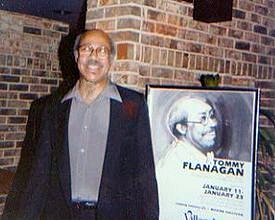
Some of the most famous piano solos in jazz were played by a man most listeners could not name: Tommy Flanagan. In jazz journalist Gene Rizzo's ranking of the fifty greatest jazz piano players, Flanagan places eighth, celebrated first as a peerless accompanist and then, belatedly, as a soloist of rare taste and harmonic finesse.
This profile covers who Tommy Flanagan was, how a Detroit pianist became jazz's go-to accompanist, what defined his elegant style, and the recordings — plus scores — to start with today.
The short answer: Tommy Flanagan (1930–2001) was an American pianist from Detroit whose horn-like lines, understated left hand and impeccable taste made him the accompanist of choice for singers and soloists — and, in his later years, a deeply admired leader in his own right.
Life and career
Flanagan was born in Detroit in 1930, started on clarinet at six and switched to piano at ten. Some of his first professional jobs, at fifteen, were played alongside tenor saxophonist Dexter Gordon, and he became a fixture of the fertile Detroit jazz scene, working as house pianist at clubs like the Blue Bird Inn.
He moved to New York in 1956 and almost immediately made history as a sideman, recording on Sonny Rollins's Saxophone Colossus (1956) and John Coltrane's Giant Steps (1959) — the latter home to one of the most scrutinized piano solos in jazz. He placed fifth among pianists in the 1960 Downbeat International Critics' Poll, an early sign of the esteem his peers held him in. He spent years as accompanist to singers Ella Fitzgerald and Tony Bennett, and only from the mid-1970s did producers push him into the spotlight as a leader. He kept recording superb trio albums until his death in 2001.
Style and influence
Flanagan's style grew out of Bud Powell's — long, serpentine single-note lines that echo Powell's paraphrases of Charlie Parker — but he made it his own with a lighter touch and a beautifully understated left hand that outlines the harmony without cluttering it. Rizzo credits him with "one of the most enviable accompanist résumés this side of Jimmy Rowles."
He is often compared with the pianist Hank Jones, another model of elegance and reliability. And after Bill Evans died in 1980, Flanagan quietly carried forward the interdependent, three-way trio conception Evans had pioneered, proving it could serve a mainstream, swinging style as well as an impressionist one.
Essential recordings
| Recording | Label / year | Why it matters |
|---|---|---|
| Overseas | Prestige, 1957 | An early trio masterpiece recorded in Stockholm; a benchmark of taste and swing |
| Saxophone Colossus (Sonny Rollins) | Prestige, 1956 | Career-defining sideman work on a jazz landmark |
| Something Borrowed, Something Blue | Galaxy, 1978 | A leader date from the years he finally stepped forward |
| Jazz Poet | Timeless, 1989 | A mature, widely praised trio album with George Mraz and Kenny Washington |
Play Tommy Flanagan's music
Flanagan was an interpreter's interpreter, so the way in is through the standards and modern classics he made his own. Study his famous solo on John Coltrane's "Giant Steps," Billy Strayhorn's ballad "Lush Life," which he loved, and the standard "Like Someone in Love." A few of these pieces are open on MuseScore below, in arrangements from approachable to advanced.
Where Tommy Flanagan ranks among jazz pianists
Rizzo places Flanagan eighth, between André Previn and George Shearing, a fitting spot for a musician whose artistry took decades to get its due. See the full list in our guide to the best jazz pianists of all time, and trace his line back to Bud Powell. To understand the harmony he outlines so gracefully, start with our guide to jazz chord progressions.
Frequently asked questions
What is Tommy Flanagan famous for?
For his impeccable accompaniment — including years with Ella Fitzgerald — and for the piano solo on John Coltrane's "Giant Steps," one of the most studied in jazz. Later he became a celebrated trio leader.
Who did Tommy Flanagan play with?
Among many others, Sonny Rollins, John Coltrane, Ella Fitzgerald and Tony Bennett; he was one of the most in-demand accompanists of his era.
What should I listen to first?
Start with Overseas (1957) for the early trio, then Jazz Poet (1989) to hear his mature, harmonically refined playing.
See scores on MuseScore
Rate this article
Be the first to rate this articleSee more

Virtual piano
Play a piano in your browser — use your mouse, touch, or computer keyboard. Real piano sound, and a free Pro tab with up to 61 keys, sustain, MIDI keyboard input, a metronome, and recording.

Keyboard ear trainer
Hear a note, then click the matching key on the on-screen piano — with instant feedback, the right key revealed on a miss, and a running score.

Metronome
Set the tempo and time signature and practice in steady time, or open the Pro tab for subdivisions, per-beat accents, a speed trainer, a gap trainer, click sounds, and recording yourself under the click — all free, right in your browser.

Scale finder
Pick a root note and a scale type — major, minor, the modes, pentatonic, blues — and see every note light up on the piano, spelled out for you.

Chord finder
Pick a root note and a chord type — major, minor, sevenths, suspended and more — and see the chord on the piano, named and spelled out for you.

Note finder
Pick a note and see every place it sits on the piano keyboard, named — and tap any key to hear it.