Dick Hyman
·
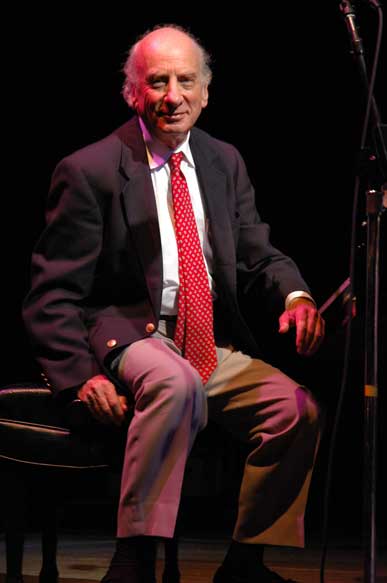
Want to hear a convincing Scott Joplin rag, a note-perfect James P. Johnson stride, a Willie "The Lion" Smith flourish, and a passage of avant-garde abstraction — all from the same pianist in one sitting? Dick Hyman is the man who can do it. A scholar-virtuoso who can reproduce almost any style in jazz history, he lands at number 32 in jazz journalist Gene Rizzo's ranking of the greatest jazz pianists, where Rizzo calls him "a musical chameleon" — with a catch we'll come to.
This profile covers who Dick Hyman is, how a Teddy Wilson pupil became jazz's great re-creator of past styles, why his own voice stays hard to pin down, and the recordings — plus scores — to start with today.
The short answer: Dick Hyman (b. 1927) is an American pianist, organist, composer, and arranger from New York whose command of every idiom from ragtime to the avant-garde makes him jazz's foremost stylistic chameleon and a favorite of filmmakers.
Life and career
A native New Yorker, Hyman studied at Columbia University and won a radio jazz-piano contest whose prize — a dozen lessons with his idol Teddy Wilson — set his course. Wilson praised his technique and started him on Chopin etudes, and Hyman later paid tribute in his arrangement of "If I Had You" for Woody Allen's film Everyone Says I Love You.
His career reads like a tour of mid-century American music: house pianist at Birdland in the late 1940s, work with Red Norvo and a European tour with Benny Goodman, an MGM contract that produced the 1956 trio hit "Moritat," ragtime recorded under the pseudonym Knuckles O'Toole, and even a stint as an early adopter of the Moog synthesizer. He revived his jazz career in the late 1960s, scored several Woody Allen films, and long served as artistic director of the "Jazz in July" series at New York's 92nd Street Y. Still living in 2026, at 99, he is among the last direct links to the swing-era pianists he grew up admiring.
Style and influence
Hyman's gift is total stylistic recall. For lecture-recitals he has re-created Joplin, Fats Waller, James P. Johnson, Willie "The Lion" Smith, and Duke Ellington so faithfully that the impersonation becomes the art — a living history of jazz piano played by one pair of hands. His technique, schooled by Teddy Wilson and rooted in the same tradition as Art Tatum, is flawless across every idiom.
That versatility is also Rizzo's reservation. When a player can sound like everyone, it becomes hard to say what he himself sounds like; as Rizzo puts it, "the real Dick Hyman remains a phantom without a calling card." It is less a criticism than a paradox — the price of mastering so many voices is that your own can hide among them.
Essential recordings
Hyman's discography is vast; these entries show both the historian and the improviser:
| Recording | Label / year | Why it matters |
|---|---|---|
| Live at Café des Copains | Music & Arts, 1988 | A solo concert that ranges across the whole jazz-piano tradition — the chameleon in full flight |
| Dick and Derek at the Movies | Arbors, 1998 | Duo-piano film themes with Derek Smith; playful, virtuosic two-piano interplay |
| Scott Joplin: The Complete Piano Works | RCA, 1975 | His authoritative ragtime survey — a benchmark of the 1970s Joplin revival |
| Moog: The Electric Eclectics of Dick Hyman | Command, 1969 | An early Moog-synthesizer record that shows his restless appetite for new sounds |
Play Dick Hyman's music
Because Hyman is jazz's great interpreter, the way in is through the repertoire he revived. Try Scott Joplin's "The Entertainer" or "Maple Leaf Rag" the way Hyman played them, then reach for a stride showpiece. A few of the pieces he's famous for performing are open on MuseScore below.
Where Dick Hyman ranks among jazz pianists
Rizzo places Hyman at 32, honoring a technician whose range has few equals. See the full list in our guide to the best jazz pianists of all time, and compare Hyman with his teacher Teddy Wilson and the stride and virtuoso masters he re-creates, Fats Waller and Art Tatum. To explore the harmony behind the styles he mimics, start with our guide to jazz chord progressions.
Frequently asked questions
Is Dick Hyman still alive?
Yes. Born in 1927, Hyman is still living in 2026, at 99, having remained active as a pianist, arranger, and educator into his later years. He is one of the last surviving links to the swing-era pianists he studied.
What is Dick Hyman best known for?
He is celebrated as a stylistic chameleon who can convincingly re-create any era of jazz piano, from ragtime to the avant-garde, and as the pianist and arranger behind the scores of several Woody Allen films.
What should I listen to first?
Start with the solo album Live at Café des Copains (1988) to hear his range in one sitting, then his RCA survey of Scott Joplin's piano works for the ragtime side of his art.
See scores on MuseScore
Rate this article
Be the first to rate this articleSee more

Virtual piano
Play a piano in your browser — use your mouse, touch, or computer keyboard. Real piano sound, and a free Pro tab with up to 61 keys, sustain, MIDI keyboard input, a metronome, and recording.

Keyboard ear trainer
Hear a note, then click the matching key on the on-screen piano — with instant feedback, the right key revealed on a miss, and a running score.

Metronome
Set the tempo and time signature and practice in steady time, or open the Pro tab for subdivisions, per-beat accents, a speed trainer, a gap trainer, click sounds, and recording yourself under the click — all free, right in your browser.

Scale finder
Pick a root note and a scale type — major, minor, the modes, pentatonic, blues — and see every note light up on the piano, spelled out for you.

Chord finder
Pick a root note and a chord type — major, minor, sevenths, suspended and more — and see the chord on the piano, named and spelled out for you.

Note finder
Pick a note and see every place it sits on the piano keyboard, named — and tap any key to hear it.